
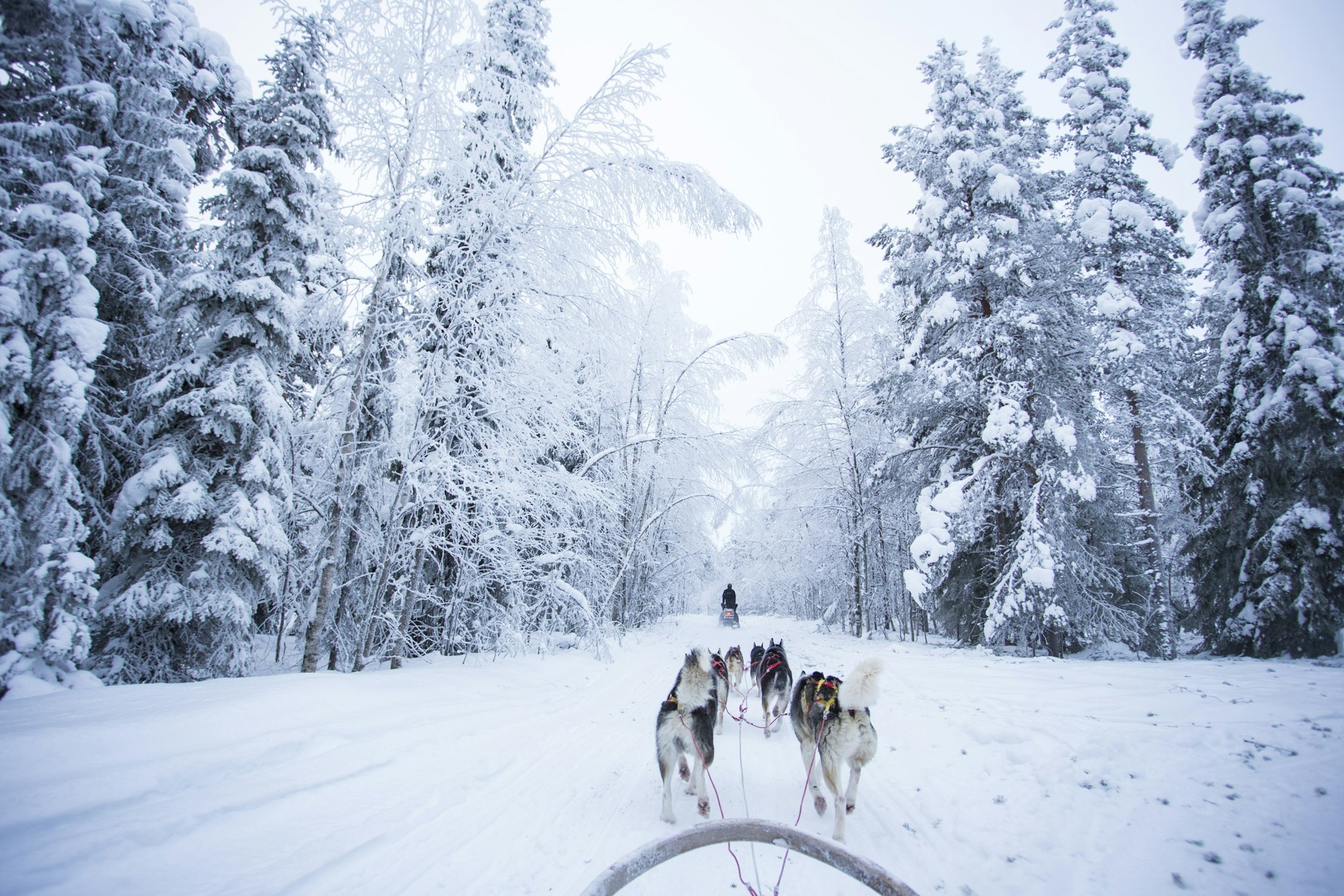
Driving Change in Animal Tourism
Hetta Huskies' role in a Finnish research project bringing tourism companies together to challenge practices and improve transparency in sleddog welfare.
Slowly, slowly, slowly. In summer 2016, 11 Finnish tourism companies joined the Multidimensional Tourism Institute (MTI) of the University of Lapland on 'Animals and Responsible Tourism: Promoting Business Competitiveness through Animal Welfare'. It was the culmination of Anna's 3-year goal to bring companies to the table on sleddog welfare practices and transparency for customers.
- 11 Finnish tourism companies joined the MTI / University of Lapland project (summer 2016)
- Project: 'Animals and Responsible Tourism: Promoting Business Competitiveness through Animal Welfare'
- Funded primarily by Tekes under the European Regional Development Fund (ERDF)
- Each participating company contributed at least EUR 1000
- Driven by Anna's 3-year goal to challenge sleddog welfare practices and build transparency
The project and its partners
Most funding came from Tekes, the Finnish Funding Agency for Innovation, under the European Regional Development Fund (ERDF). Each company also contributed at least EUR 1000, plus the time and cost of travel across Lapland over the 2-year project.
Alongside Hetta Huskies / CAPE Lapland Oy, the participants are Lapland Safaris, Harriniva, Ranua Wildlife Park, Arctic Reindeer, Arctic Husky Farm, Northern Gate Safaris, Nurminiemen Ratsutila, OFF-Piste Adventures, Polar Lights Tours and Ruska Laukka, with three international partners including David Fennell (Professor, Brock University) and Joonas Rokka (EMLYON Business School).
Quality in animal tourism services
Quality in animal-based tourism has three faces. For the animal: personality and species-specific needs, feeding, care, safety and training, in relation to work, environment and equipment. For the customer: safety and cleanliness. For the employee: sufficient resources, transparency and ongoing monitoring and training.
Animals are the core of many tourism businesses in Northern Finland, so quality starts with their welfare. When the animal does well, customers, employees and entrepreneurs all do well.
A pragmatic approach to change
The project treats optimal welfare pragmatically, in a way that makes business sense. Change comes from shifting perspective until a tipping point, and mandatory public transparency about base and optimal standards, against which the public can choose, is one route there.
What nobody needs is a public scared into believing the sport is inherently bad. That would put even the dogs on high-quality farms at risk. Activists would do better campaigning for geriatric sleddog care than for a ban on the industry.
We are mushers and we are proud
Mushers are a misunderstood group. We find a society within our kennels, with our dogs, fellow mushers and families. 'All those dogs' are our family, our village, our hearts living outside our bodies. We know their names, their personalities, when they are happy and when they might be sad.
This is a lifestyle, not an occupation. Our dogs are our coworkers, our friends and a furry neck to nuzzle when the world gets too hard. Many will misunderstand us, and that's ok, but we are Mushers and we are Proud. (Gina Phillips, Krabloonik Dogsledding, CO.)
Good to know
- Funding
- Tekes / European Regional Development Fund (ERDF)
Ready when you are
Real wilderness, 200+ huskies, eighteen winters in.