
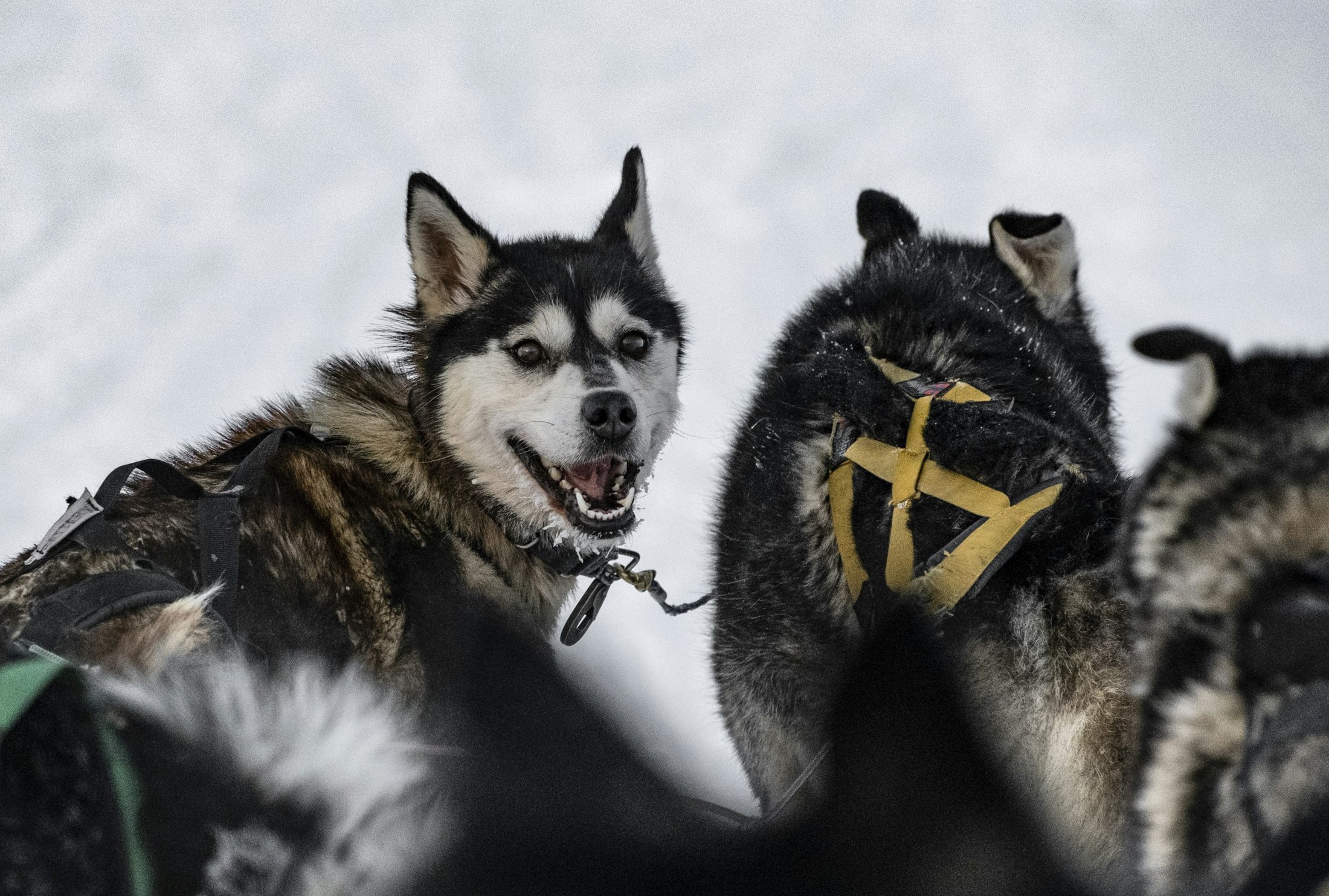
P.R.I.D.E.'s Voluntary Codes of Practice
The full Mush with P.R.I.D.E. voluntary sled-dog care guidelines reproduced in detail, covering dog-yard housing, feeding and watering, training and conditioning and more.
P.R.I.D.E. stands for Providing Responsible Information on a Dog's Environment. The bond between sled dogs and humans is one of the oldest of its kind, and modern owners are proud of their dogs as canine athletes bred and trained to do what they love, run as part of a team.
Mush with P.R.I.D.E. is dedicated to the responsible care and humane treatment of sled dogs. Its voluntary guidelines can be downloaded, and we reproduce them below for comparison with the British Columbia voluntary codes of best practice.
- P.R.I.D.E. = Providing Responsible Information on a Dog's Environment
- Dog yard for 10 dogs: at least 1,000 sq ft of pens, or 1,450 sq ft for tethers
- Recommended minimum 100 sq ft of space per dog in fenced runs or pens
- Tether chains 5-7 ft long on posts 3-4 ft high, always with at least one swivel, never cable
- Dogs should NOT be continuously housed on concrete, and waste should be cleared at least once a day
- Quality feed: minimum 15% fat and 25% protein, with body condition checked by hand every 2-3 days
- Full PRIDE care guidelines reproduced and compared with British Columbia's voluntary codes of best practice
About the Guidelines
Since the 2nd Edition of the Mush with P.R.I.D.E. Sled Dog Care Guidelines, scientists studying working sled dogs, often with the support of their mushers, have made great strides in understanding dog physiology, psychology and behaviour, validating care methods practised for more than a century while challenging other long-held traditions.
Built on the consensus of dozens of the world's most experienced mushers, the Guidelines describe responsible, humane and practical care and training. First published in 1993, they are among the world's most respected and widely distributed resources on good sled dog care.
02The Dog Yard and Housing
Beginner mushers are often surprised by how much space a kennel needs: a dog yard for 10 dogs requires at least 1,000 square feet of pens, or 1,450 square feet for tethers. Choose a dry, well-drained spot, on a slight slope or high point for springtime drainage, with shade to keep the dogs cool in summer and a sunny, wind-protected aspect for winter.
Soil suits well-drained sites but harbours disease organisms and demands diligent feces pick-up, while sand, wood chips, wooden platforms or fine gravel suit wetter ground. The Guidelines Committee firmly stresses that dogs should NOT be continuously housed on concrete, and any kept on it must exercise on other surfaces several hours each day. Cleaning up waste at least once a day keeps the yard pleasant and helps control diseases such as parvovirus and intestinal parasites.
03Confinement Systems
Your confinement system must reliably prevent escape while allowing room to move freely and to run and jump.
- Tethering: a common, traditional and economical method, and the only controlled scientific study comparing tethered dogs with penned ones found no evidence it is unsafe or inhumane (Houpt K)
- Chains: need at least one swivel to prevent tangles that can choke a dog
- Cable: should never be used, as it wraps around legs and can cinch like a snare
- Tether dimensions: with a top-mounted post and swivel chain, each dog needs a strong chain of 5 to 7 ft on a post about 3 to 4 ft high
- Exercise room: a 5 ft chain gives slightly more than 78 square feet, a 7 ft chain nearly 155 square feet
- Pens: fenced runs or pens should give at least 100 square feet per dog
- Fencing: chain-link or woven-wire, buried 6 to 12 inches into the ground and at least 5 ft high to discourage climbing
- Intact females: need a secure heat pen to prevent unplanned litters
05On-the-Road Housing
Dogs should travel restrained in dog boxes or airline crates, to prevent injury to themselves and other occupants of the vehicle. Boxes should be large enough to stretch and turn around in, with dry bedding, adequate ventilation, user-friendly latches and a secure attachment to the vehicle. They should not be open or vented at the rear of the truck, as the vacuum behind it can suck in exhaust fumes.
Dogs should be taken out ('dropped') several times a day, and can safely be left for eight hours at night as long as the vehicle is stationary. Keep water buckets clean, avoid parking where other dogs have been to limit exposure to disease and parasites, and always rake up straw and waste and dispose of it properly.
06Feeding and Watering
Sled dog sports span many breeds, sizes and climates, so there is no single perfect diet: the ideal depends on a dog's genetics, age, physical state, training regimen, environment and available food sources. Whether you feed commercial dry food, meat-based food or a combination, choose a fresh product of the highest quality available, relatively high in fat (15% minimum) and protein (25% minimum), as poor-quality pet foods cannot sustain working sled dogs.
Monitor body condition by running your hands over the dog every two or three days: the ribs, spine and hip bones should be easy to feel but neither buried in fat nor protruding. At peak demand a sprint dog may need two to three times its off-season food, and a long-distance racing dog three to six times, with intake adjusted again for pregnancy, lactation, growth and old age.
07Water
Water is the most essential part of a feeding regime. Deficiencies in protein, fat, vitamins or minerals may take days or months to show, but dehydration affects health immediately and, untreated, can be fatal within hours. A dog's water requirement may double during open-class sprint racing and rise three to five-fold during long-distance racing.
In warm weather, keep clean, fresh water available at all times. Below freezing, encourage drinking by offering warm, baited water. Give about 1½ quarts two to three hours before training, with smaller amounts afterwards to help cool the dogs down. Monitor hydration by the dogs' hunger for snow and by checking that a lifted skin-tent on the shoulder disappears within one to two seconds.
08Training and Conditioning
Training falls broadly into two categories, education and physical conditioning, with the right schedule depending on your dogs' activity, climate, terrain, age and breed. Weigh your goals against your dogs' abilities: counting miles alone is deceptive, as steep hills, heavy snow, extreme temperatures and wind all count too.
Anything you do repeatedly is educational, so be sure you want your dogs to learn it and never send mixed messages. New mushers should consult books and experienced mushers, but also use common sense: never ask your dogs to do more than you are reasonably certain they can accomplish.
Good to know
- Source
- Mush with P.R.I.D.E. Sled Dog Care Guidelines (3rd Edition)
Ready when you are
Real wilderness, 200+ huskies, eighteen winters in.
04
Social and Psychological Stimulation
›Recent research indicates that social and psychological stimulation in the housing area may matter even more to a dog's physical and mental health than space. Dogs are highly social and thrive where they can see, smell and safely play with each other, while isolation from teammates is associated with more behavioural abnormalities.
Provide toys, chew bones and other safe objects, rotated frequently between dogs. Interact with each dog while doing chores and, above all, take them on frequent training and conditioning runs, as working with teammates amid the sights and scents of the trail is the best possible stimulation for working dogs. If you live near others, teach your dogs to be quiet out of respect for their right to peace.